
Loan Against Property in India: Complete Guide to Rates, Eligibility & Maximum Funding (2026)
Property-rich but cash-constrained—this is a financial bottleneck that many Indian business owners and professionals know intimately. Consider a factory owner in Howrah with ₹1 Crore tied up in his workshop floor, a doctor in Salt Lake with a fully paid-off clinic, or a Siliguri trader who owns a warehouse but cannot tap into its equity for seasonal inventory finance.
The asset is undeniable, and the mechanism to monetize it without outright divestment exists. Yet, between "I own a property" and "funds are in my account," most applicants encounter a processing administrative loop they weren't prepared for—frequently resulting in a loan sanction that comes in 20% to 30% below what the property's market value initially suggested.
This comprehensive guide covers the complete lending landscape in 2026: how interest rates are priced, how the Loan-to-Value (LTV) ratio is calculated, the three critical factors that cause more application failures than a low credit score, tax optimization strategies, and the essential paperwork required before you apply.
Comparing Loan Against Property (LAP) offers solely on the headline interest rate misses the true cost of borrowing. Two offers at 9.5% p.a. can differ by ₹2–3 Lakh in total outgo over a 15-year tenure once processing fees, prepayment penalties, and bundled insurance premiums are factored in. At CreditCares, we evaluate the all-in cost across 30+ lenders to protect your bottom line.
What is a Loan Against Property?
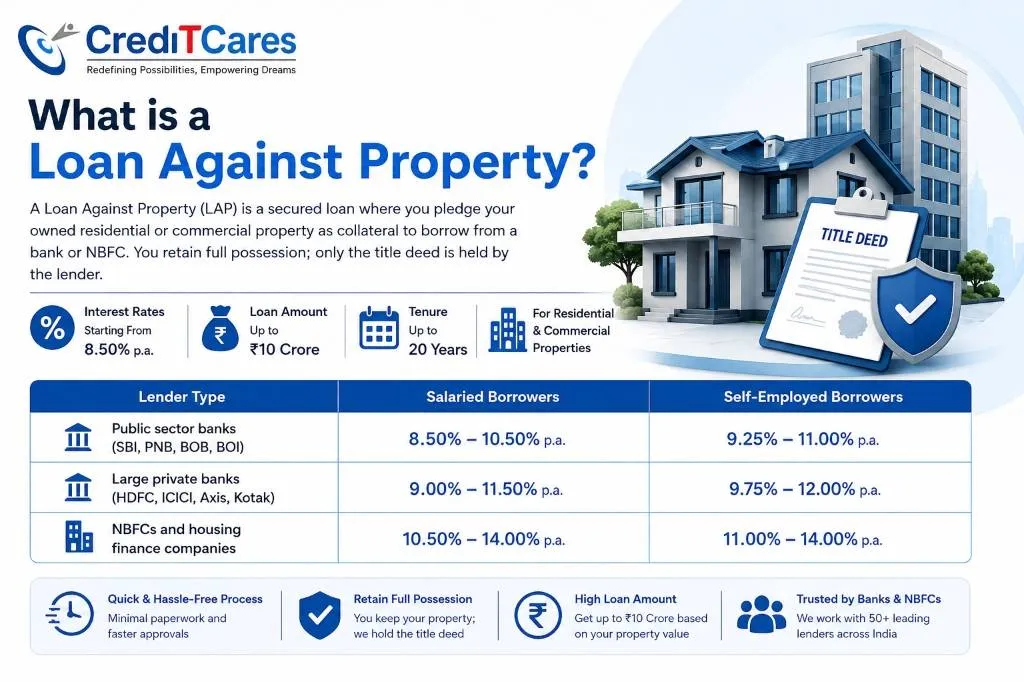
A Loan Against Property (LAP) is a secured loan that allows you to borrow a substantial sum against the current market value of a property you already own—without selling the asset or relinquishing possession.
Unlike a standard home loan, which specifically funds the purchase of a new property, a LAP offers total end-use flexibility. Capital can be deployed for any legitimate financial purpose, including:
- Business expansion or infrastructure upgrades
- Infusions of operational working capital
- High-interest debt consolidation
- Higher education abroad
- Immediate medical contingencies
Whether your asset is residential, commercial, or industrial, it remains fully occupied and under your control. The lender registers a mortgage and retains the title deeds as security purely until the liability is liquidated.
The Mechanics: LTV and Tenure
The final loan amount is calculated as a percentage of the property's appraised value, known as the Loan-to-Value (LTV) ratio. Under current Reserve Bank of India (RBI) prudential guidelines, commercial banks cap LTV ratios at 75% for loans up to ₹75 Lakh, and at 65% for loan exposures exceeding ₹75 Lakh. Non-Banking Financial Companies (NBFCs) operate under board-approved internal metrics but generally anchor their risk frameworks within a similar 55% to 75% bracket. Repayment is structured via Equated Monthly Installments (EMIs) spread across flexible tenures of up to 20 years.
Who Can Apply: Eligibility Criteria in 2026
To qualify for a LAP, an applicant must demonstrate a stable, verifiable income stream paired with a clean, legally clear property title. Lenders evaluate three core pillars: applicant profile, creditworthiness, and property compliance.
Profile Matrix and Income Proof
| Applicant Profile | Age Bracket | Max Age at Loan Maturity | Core Documentation Requirements |
|---|---|---|---|
| Salaried Individuals (Private, MNC, PSU, Govt) |
21–60 Years | 60 Years | 3 Months' Salary Slips + Form 16 / 2 Years' ITR |
| Self-Employed Professionals (CAs, Doctors, Lawyers) |
25–65 Years | 65 Years | 3 Years' ITR + CA-Certified Balance Sheets |
| Business Owners (Proprietors, Partners, Directors) |
25–70 Years | 70 Years | 3 Years' ITR + P&L Statements + GST Returns |
| Non-Resident Indians (NRIs) (With Indian Property) |
Variable | Variable | Foreign Income Proof + RBI-Compliant Power of Attorney (PoA) |
Credit Risk and Cash Flow Metrics
- CIBIL Score Benchmarks: Traditional commercial banks mandate a minimum CIBIL score of 700, with prime pricing unlocked at scores above 750. Credit scores ranging between 650 and 700 are routinely routed to specialized NBFCs, which typically carry a risk premium of 0.5% to 1.0%. Scores slipping below 650 trigger immediate rejections at primary commercial institutions, though selective asset-backed NBFCs may step in with tighter LTV caps.
- Fixed Obligation to Income Ratio (FOIR): Lenders systematically restrict aggregate monthly debt obligations to 50% or 55% of your net monthly income. Existing commitments—such as car loans, personal loans, and minimum credit card balances—directly erode this allocation. For instance, if ₹35,000 of an applicant’s ₹85,000 net monthly salary is already servicing debt, only ₹10,000 to ₹12,750 remains as compliant FOIR headroom for a new LAP installment. This remains the most overlooked constraint in underwriting math.
Want to see where your profile stands? Use our Loan Eligibility Checker to generate an instant risk-profile estimate before initiating formal inquiries.
LAP vs. Personal Loan vs. Home Loan
Selecting the appropriate credit instrument depends entirely on your available assets, borrowing scale, and targeted repayment runway.
| Feature | Loan Against Property (LAP) | Personal Loan | Home Loan |
|---|---|---|---|
| Primary End-Use | Any legitimate financial purpose | Any legitimate financial purpose | Property purchase or construction only |
| Interest Rates (2026) | 8.50% – 14.00% p.a. | 11.00% – 22.00% p.a. | 8.30% – 10.00% p.a. |
| Quantum of Credit | ₹5 Lakh – ₹10 Crore+ | Up to ₹30 – ₹40 Lakh | Based on purchase contract value |
| Maximum Tenure | 20 Years | 5 – 7 Years | 30 Years |
| Collateral Required | Yes (Fully owned property) | None (Unsecured) | Yes (The property being financed) |
| Turnaround Time | 7 – 15 Working Days | 1 – 3 Working Days | 15 – 30 Working Days |
| LTV Boundaries | 55% – 75% of asset valuation | Not Applicable | Up to 80% – 90% of contract value |
| Tax Reductions | Sec 24(b) (Property) / Sec 37(1) (Biz) | None | Section 24(b) + Section 80C |
| Prepayment Penalties | Nil for individual floating-rate | Typically 2% – 4% of principal | Nil for floating-rate structures |
- When LAP is superior: You require a capital injection exceeding ₹30 Lakh, want to amortize liabilities over a comfortable 15-to-20-year window, and want an interest rate significantly below unsecured personal lines of credit.
- When a Personal Loan is superior: You need capital cleared within 24 to 48 hours, require a sum under ₹20 Lakh, and refuse to register a legal mortgage against your real estate holdings.
Are you a corporation or commercial enterprise reviewing funding alternatives? Explore our Working Capital Loans and MSME Financing frameworks for dedicated, asset-backed commercial lines of credit.
Loan Against Property Interest Rates in 2026
Interest rates for LAPs currently range from 8.50% to 14.00% p.a. Your precise interest rate is determined by an intersecting matrix of credit history, employment classification, the underlying asset type, and the lender’s regulatory tier.
Representative Pricing Matrix (Mid-2026)
| Lender Classification | Salaried Borrowers | Self-Employed & Businesses |
|---|---|---|
| Public Sector Banks (SBI, PNB, BOB, BOI) |
8.50% – 10.50% p.a. | 9.25% – 11.00% p.a. |
| Tier-1 Private Banks (HDFC, ICICI, Axis, Kotak) |
9.00% – 11.50% p.a. | 9.75% – 12.00% p.a. |
| NBFCs & Housing Finance Cos. | 10.50% – 14.00% p.a. | 11.00% – 14.00% p.a. |
Note: These metric bands represent public disclosures as of mid-2026. Final loan covenants are contingent on individual asset appraisals and active credit policies. Model your specific layout with our interactive LAP EMI Calculator.
Interest Frameworks & Sustainability Incentives
- Floating vs. Fixed Rate Dynamics: The dominant share of 2026 LAP inventory is structured on floating-rate mechanisms linked directly to a lender's Marginal Cost of Funds Based Lending Rate (MCLR) or the RBI’s Repo Rate External Benchmark (EBLR). While fixed-rate structures are accessible via select institutions, they command a premium of 150 to 250 basis points—justifiable only if long-term macroeconomic volatility is anticipated.
- The Emerging "Green LAP" Concession: In alignment with modern ESG frameworks, major institutions like SBI and HDFC Bank offer a specialized 10 to 25 basis point pricing concession. This discount triggers if the pledged asset holds an official IGBC (Indian Green Building Council) rating, or if the loan proceeds are legally bound to green facility upgrades like industrial solar configurations, EV charging hubs, or sustainable renovations.
How Lenders Calculate Your LTV — A Worked Example
Lenders will not simply adopt an applicant's assumed market value. They apply their maximum LTV percentage to the lower of two values: the active market pricing or the technical valuation determined by their independent, empanelled surveyors.
Standard LTV Allocations by Real Estate Category:
- Residential Real Estate (Self-Occupied/Tenanted): 65% – 75% LTV
- Commercial Properties (Offices, Retail Layouts, Corporate Spaces): 55% – 65% LTV
- Industrial Facilities (Manufacturing Units, Warehouses, Workshops): 40% – 60% LTV
- Vacant Land Parcels (Approved Layouts via Select NBFCs): 30% – 40% LTV
- Agricultural Land: Excluded from standard LAP underwriting by major commercial institutions.
When a property-backed credit line is rejected or severely downsized, applicants typically blame their credit score. In reality, credit risk officers point to three separate systemic triggers far more frequently:
- Unreleased Title Encumbrances ("Ghost Mortgages"): Properties carrying historic liabilities from the 1990s or early 2000s—even if paid off completely—frequently hold active encumbrances if the primary lender failed to file a formal satisfaction memorandum with the local Sub-Registrar. This legacy friction appears immediately on an Encumbrance Certificate (EC). In regions like West Bengal, these unreleased entries regularly stall clear title searches, resulting in sudden 3-to-6-week operational bottlenecks or outright file rejections. Pulling a comprehensive 30-year EC prior to application is a vital preemptive measure.
- Structural Deviations from Sanctioned Building Plans: Municipal clearances and physical, real-world construction frequently conflict. Unapproved mezzanine installations, floor additions, or setback violations are easily flagged by technical surveyors. The standard risk response is to calculate loan metrics strictly using the legally compliant, as-sanctioned square footage. For older industrial sectors in areas like Howrah, Liluah, or Asansol, this structural deduction can slash mortgageable value by up to 40%, depressing final credit deployment.
- Latent Debt-Obligation Absorption: If existing personal lines, credit facilities, or asset loans devour 40% to 45% of your documented monthly incoming cash flow, your available underwriting space collapses. The loan sanction is engineered backward from your maximum sustainable monthly debt capacity, rather than forward from the asset value. Retiring high-interest unsecured lines of credit prior to underwriting can expand final loan approvals by 20% to 30%.
The Challenge: A precision engineering business owner in Howrah sought a ₹65 Lakh loan against his workshop-cum-godown, which carried an estimated market value of ₹1.1 Crore. Under traditional industrial asset rules (60% LTV), the target was viable. However, the bank surveyor flagged an unauthorized industrial mezzanine floor, revising the compliant real estate value downward to ₹85 Lakh. This compressed the maximum available bank sanction to ₹51 Lakh, leaving a ₹14 Lakh deficit.
The Strategy: Advisors restructured the deal architecture by integrating a secondary asset: a residential apartment in Shibpur owned by the entrepreneur's spouse, who joined as a co-applicant. The residential flat, valued at ₹48 Lakh, qualified for an optimized 70% residential LTV (₹33.6 Lakh).
The Outcome: Combining the cross-collateralized assets produced an aggregate credit approval of ₹84.6 Lakh (₹51 Lakh + ₹33.6 Lakh), seamlessly covering the client's asset requirements.
Documents Required for a Loan Against Property
Gathering your document suite in advance is the single most effective way to protect your processing timeline. Incomplete file submissions account for the majority of multi-week turnaround delays.
Core Know-Your-Customer (KYC) Identity Documents
- Aadhaar Card, PAN Card, Passport, Voter ID, or valid Driving License.
Financial Credentials — Salaried Borrowers
- Consecutive 3 Months' Salary Slips.
- Past 6 Months' Bank Statements (Primary Salary Credit Account).
- Form 16 documentation and Income Tax Returns (ITR) spanning the past 2 financial years.
- Primary Employment Appointment Letter or official HR validation.
Financial Credentials — Self-Employed & Corporate Entities
- Comprehensive Income Tax Returns paired with full computing schedules for the past 3 fiscal years.
- Balance Sheets and Profit & Loss statements audited or certified by a Chartered Accountant.
- Statutory Business Certifications: GST Registration Certificates, Active Trade Licenses, or Articles of Incorporation.
- Past 12 Months' Operative Bank Statements across both primary corporate current accounts and individual accounts.
Essential Real Estate Documentation
- Original registered Sale Deed and Title Deed chain tracking previous transfers of ownership.
- Local municipal-approved structural plans paired with formal Occupancy or Completion Certificates.
- Validated receipts for up-to-date Property Tax payments.
- Formal Encumbrance Certificate (EC) covering a minimum timeline of 13 years (a 30-year track is highly recommended).
- Non-Objection Certificate (NOC) from the registered housing society if applicable.
- Valid property insurance documentation where available.
Tax Benefits on a Loan Against Property
The tax treatment of a LAP is dictated exclusively by how the funds are deployed—not by the underlying real estate asset class.
- Section 24(b) — Interest Deductions for Real Estate Upgrades: When LAP proceeds are directly routed into purchasing, building, or renovating a residential asset, the interest component of the EMI qualifies for deductions under Section 24(b) of the Income Tax Act. This relief is capped at ₹2 Lakh annually for self-occupied real estate, while tenured rental assets enjoy no upper cap when balanced against active rental returns. Clear asset mapping and bank trails are mandatory to sustain these claims during assessment.
- Section 37(1) — Business Expense Deductions for Commercial Use: When a LAP is harnessed as an operational tool—funding machinery acquisitions, supporting working capital cycles, or liquidating commercial trade debt—the absolute interest component paid can be written off as a legitimate business expense under Section 37(1). This introduces a powerful structural advantage for corporate entities: standard residential home loan interest write-offs are capped at ₹2 Lakh, whereas business-centric LAP interest write-offs carry no upper fiscal boundary.
Crucial Caveat: Loans Against Property do not offer principal repayment deductions under Section 80C. If your core goal is maximizing Section 80C rebates, standard Home Loans remain structurally distinct.
Frequently Asked Questions (FAQ)
- Explore our detailed manual on Cash Credit Facilities
- Read our complete execution guide for Project Finance and Machinery Loans
Regulatory Disclosure: The content of this document serves purely educational functions. Stated interest rates, LTV allocations, and general underwriting parameters represent market-average ranges for mid-2026 and remain subject to sudden adjustments based on macro lending policy shifts. Credit approval, final pricing tiers, and credit boundaries are contingent on institutional evaluations of property risk and applicant financial metrics. Tax commentary reflects high-level summaries; applicants must obtain formal verification from a certified Chartered Accountant before logging deduction claims.